
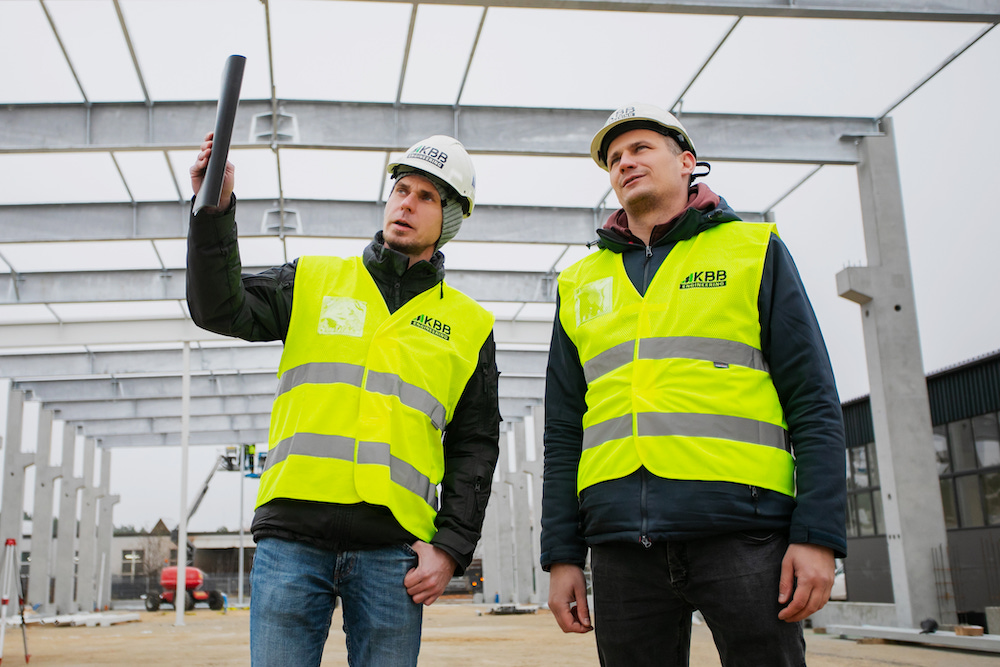
Construction of a warehouse – how to prepare for it?
Are you planning to build or expand a warehouse? This type of investment must begin with understanding your needs. This will allow the general contractor to prepare a conceptual and construction design. The site preparation process, including appropriate space development, drainage, and utilities, requires careful planning. Meeting all legal requirements and obtaining the necessary permits is equally important, requiring knowledge and experience. If you want to learn what steps to take before starting the construction of a warehouse and how to best prepare for this investment, we invite you to read our article. Here are practical tips to help you navigate the construction process smoothly and without unforeseen problems.
Does building a warehouse require a building permit?
The condition that determines whether a building permit is required is the duration of the investor’s intended use of the warehouse. If the investor plans to use the hall in one location for up to 180 days, a building permit is not required. However, if the hall is to be used in one location for longer than 180 days, a building permit will be required, as with any other construction project.
Construction of a hall – where to begin?
Before construction begins, the hall’s design phase should consider:
- square footage
- aria-level=”1″>height,
- number of doors, windows, gates, driveways,
- type of insulation,
- construction and cladding materials.
Legal requirements for warehouses
The technical requirements that warehouses must meet as construction facilities are described in the provisions of the Construction Law and the Regulation of the Minister of Infrastructure. They describe, among other things, the conditions for:
- location of the warehouse on the plot,
- strength and stability of the structure,
- fire protection,
- hygienic, health, and environmental requirements,
- safety of use and accessibility,
- protection against excessive noise,
- energy efficiency and thermal insulation,
- sustainable use of natural resources,
- disposal of sewage, rainwater, and waste.
The hall structure is most often made of steel or aluminum. Steel buildings are most often chosen for their resistance to heavy loads. Aluminum buildings, on the other hand, exhibit better anti-corrosion properties. It’s generally accepted that if a building is intended for seasonal use only, an aluminum structure is preferable, while for frequent use, steel buildings are preferred.
The type of cladding should be selected depending on the facility’s intended use and the type of products stored there. It can be made of tarpaulin, trapezoidal sheet metal, or sandwich panels.
What about expanding a building?
Starting an expansion requires a technical assessment and design preparation. Sometimes it’s necessary to dismantle an existing wall, although this is usually done after the addition is built, or avoided altogether if the new section is to be separated from the rest of the building. In such a case, the existing exterior wall becomes the interior wall. Expanding and constructing industrial facilities is a complex and detailed process that requires consideration of specific fire safety requirements and other important factors. At KBBE, we expand existing warehouses without disrupting the flow of work.